
Reviewed · EPHESUS & VIRGIN MARY TOURS
Tailor-Made Private Ephesus Tour with Local Experiences
Ephesus rewards a well-planned day. This private Kusadasi tour combines the grand ruins with Mary’s House, St. John Basilica, a local Turkish lunch, and time at the bazaar. I especially like the private Mercedes Vito and the freedom to adjust the schedule with guides such as Nagi, Asli, Selin, and Ahmet. I also like that cruise passengers receive port pickup and drop-off, which removes much of the day’s usual stress.
The main consideration is cost beyond the $75 tour price. Ephesus, Mary’s House, the Terrace Houses, and St. John Basilica all require separate admission fees, bringing the total well above the advertised base rate. The lunch is included, but the carpet-weaving stop can feel sales-oriented to some people, even though several guides keep it low-pressure.
In This Review
- Key points for planning your Ephesus day
- Why a private Ephesus tour makes sense
- Starting at the House of the Virgin Mary
- Walking through Ephesus Ancient City
- State Agora and the Odeion
- Temples along Curetes Street
- Hercules Gate and the changing city street
- The Terrace Houses and Roman home life
- The Library of Celsus
- The Great Theatre and the Christian connection
- St. John Basilica and the Temple of Artemis
- Local lunch, weaving, and Kusadasi’s bazaar
- Price, extra fees, and overall value
- Who should book this Ephesus experience?
- Should you book it?
- FAQ
- How long does the private Ephesus tour last?
- Where does pickup take place for cruise passengers?
- Is hotel pickup available in Kusadasi?
- Is airport pickup available?
- Are entrance tickets included?
- Is lunch included?
- Can the itinerary be changed?
- What is the cancellation policy?
Key points for planning your Ephesus day
- Private touring makes the schedule flexible: You can ask to skip Mary’s House, add a museum, spend longer at Ephesus, or leave out St. John Basilica.
- Cruise pickup is clearly arranged: Meet the OTTI Travel representative at the exit gate of the immigration terminal with the company sign.
- The guide is the heart of the experience: Nagi, Asli, Selin, Ahmet, Gökçe, Tas, Sergen, and others receive repeated praise for clear explanations, patience, and personal attention.
- The main archaeological visit is not rushed: The plan includes Ephesus, the Terrace Houses, the Library of Celsus, the Great Theatre, and other major ruins.
- Lunch adds a local touch: The included Turkish meal often comes with a short carpet or silk-making demonstration.
- Budget for admission separately: The listed extra fees total €79 per person if you visit every chargeable site.
Why a private Ephesus tour makes sense
Ephesus is a large archaeological area, and its most famous buildings are spread along sloping, marble-paved streets. You can see the highlights independently, but a private guide gives the remains a human scale. Instead of looking at a row of broken columns, you learn how the street worked, who used the building, and how Greek, Roman, early Christian, and Ottoman life overlap in this corner of western Turkey.
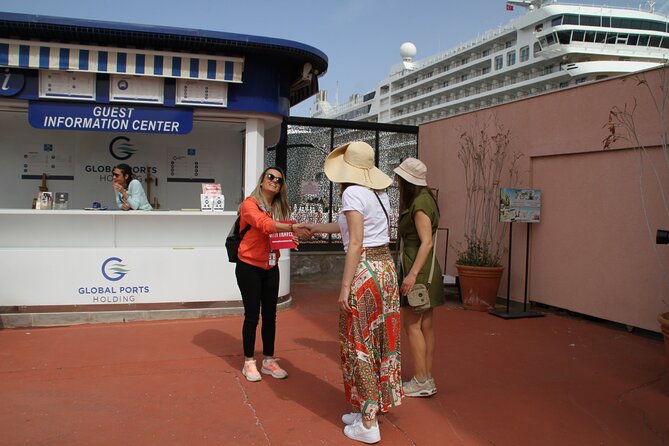
The private format is especially useful from a cruise ship. Your guide meets you at the port, your driver handles the roads, and the schedule can be shaped around your ship’s docking and re-boarding times. At booking, you need to provide the ship name, docking time, disembarkation time, and re-boarding time.
The tour lasts about six to eight hours. That is a long day, but the flexibility helps. Families can slow down for photographs. Older relatives can avoid unnecessary walking where possible. History fans can spend extra time in the Terrace Houses or at the theatre. One family even had the driver collect a mother with hip trouble after the downhill walk at Mary’s House, a practical kindness that matters more than a polished sales pitch.
The vehicle is described as a new, air-conditioned Mercedes Vito with a private driver. That is a meaningful upgrade over a crowded minibus, particularly in summer. Only your own group participates, so you are not waiting for strangers who want different stops or a different pace.
More ways to see Ephesus:
- FOR CRUISERS: Skip The Lines PRIVATE EPHESUS TOUR &On Time Return
★ 5.0 · 8,527 reviews - Top Choice For Cruisers: Ephesus, Mary’s House WITH TICKETS+LUNCH
★ 5.0 · 7,233 reviews - PRIVATE EPHESUS TOUR FOR CRUISERS: On-time Return and Skip-Line
★ 5.0 · 5,807 reviews
Starting at the House of the Virgin Mary
The House of the Virgin Mary sits on Bulbul Mountain, about nine kilometers from Ephesus. It is a small stone structure in a wooded setting, associated by tradition with Mary’s final years after she came to the area with Saint John.
The site has both Christian and Muslim associations. The original house is described as having an anteroom, bedroom, prayer room, and a room with a fireplace that later served as a chapel for Muslims. A church was built over the house and grave in the fourth century.
You need about 45 minutes here. The visit is more about quiet atmosphere and religious meaning than grand architecture. If you are interested in early Christianity, this is an important addition. If your priority is ancient urban remains, you might prefer to skip it and use the time inside Ephesus.
There is also a physical point to consider. The approach includes a steep section, and the stone surfaces around the site may be difficult for anyone with mobility concerns. Tell your guide what your group can comfortably manage. The admission fee is €18 per person and is not included.
Walking through Ephesus Ancient City

Ephesus is the day’s main event. The city grew from Greek roots into one of the major urban centers of the Roman world. It was famous for the Temple of Artemis, the Library of Celsus, its medical school, and its busy harbor connections.
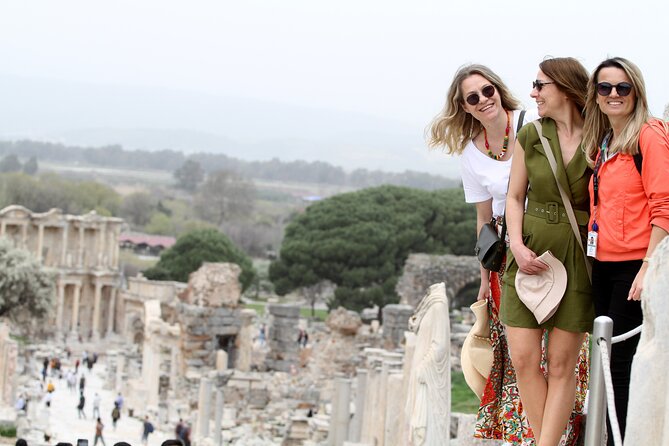
The main route gives you a sense of how a city functioned, not just a collection of monuments. You walk past public squares, theatres, temples, fountains, and private homes. The marble paving can be slippery, so sensible shoes and careful footing matter.
The stated visit to the ancient city is about 90 minutes, though the entire sequence of nearby stops gives you much longer with the site. A strong guide helps you link the pieces. Selin is praised for knowing how to avoid the heaviest crowds, while Nagi and Sergen are noted for detailed explanations about architecture, religion, language, and daily life.
The admission fee is €40 per person. Skip-the-line tickets are guaranteed, but that does not mean admission is free. Check the total cost before booking, since this is the largest extra charge.
State Agora and the Odeion
The State Agora takes about 15 minutes. Unlike a commercial marketplace, this was a governmental meeting place used for public business and official discussions during the Roman period. It also reveals earlier layers of Ephesus, including graves from the seventh and sixth centuries BC, an archaic terracotta sarcophagus, and a paved road.
A water reservoir at the corner once received water carried through the Pollio Aqueduct. The remains of that aqueduct can be seen several kilometers away along the Selçuk to Aydin road.
The nearby Odeion is a small theatre with room for about 1,500 people. It served two purposes: meetings of the city council and musical performances. Ephesus had a public assembly that met in the Great Theatre and a smaller council that used the Odeion.
These stops are brief, but they help you understand civic life. You might not remember every official title, yet you will see that Ephesus was governed, debated, entertained, and administered in purpose-built spaces.
A few more tours and experiences worth a look
- PRIVATE NO HIDDEN FEES Ephesus, Mary’s House Guided Tour /GRP OPT
★ 5.0 · 2,455 reviews - For Ship Guests:BEST SELLER EPHESUS PRIVATE TOUR & On Time Return
★ 5.0 · 2,029 reviews - Ephesus Temple of Artemis and House of Mary Private Half Day Tour
★ 5.0 · 1,573 reviews - PRIVATE TOUR FOR CRUISERS: Mary’s House (Meryemana) and Ephesus
★ 5.0 · 1,349 reviews
Temples along Curetes Street
The Temple of Hadrian is one of the most complete structures along Curetes Street. Built before AD 138, it has Corinthian columns and a curved arch decorated with a relief of Tyche, a goddess associated with fortune and victory.
The bases in front once supported statues of emperors from the late third and early fourth centuries AD. The original statues are no longer in place, but the setting shows how rulers were honored in the city.
The Temple of Domitian is less complete but politically important. It was built on a large raised terrace and was the first known Ephesus structure dedicated to an emperor. Receiving permission to become a city with an imperial temple was a major honor in the Roman system.
Each temple gets about 10 to 15 minutes. This is enough for an explanation and photographs, but not for a long study of every architectural detail. Your guide’s storytelling makes the difference. Ask how imperial worship fit alongside local Greek traditions and later Christian beliefs.
Hercules Gate and the changing city street
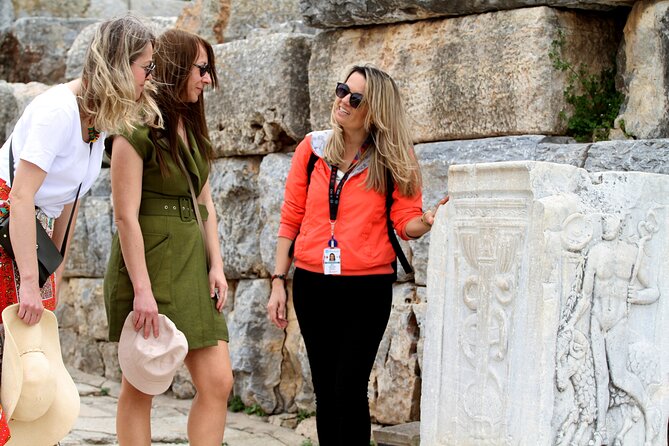
Near the end of Curetes Street, Hercules Gate is marked by two surviving column sides with reliefs of Hercules. The gate was moved to its current location in the fourth century AD, while the reliefs date to the second century.
The structure narrowed the street so vehicles could not pass. That small detail tells you something useful: by the fourth century, this part of Ephesus had become a pedestrian zone.
It is an easy stop to overlook because so little remains. I would pause here for the practical lesson. Ancient cities changed over time, and Ephesus was not frozen in one perfect Roman moment. Streets were altered, buildings reused, and monuments shifted as the city’s needs changed.
The Terrace Houses and Roman home life
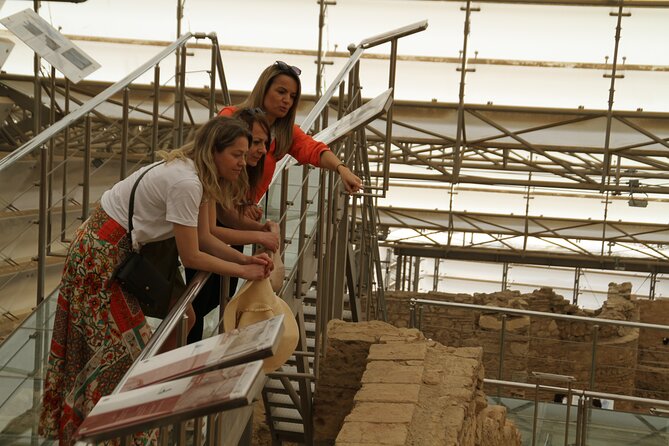
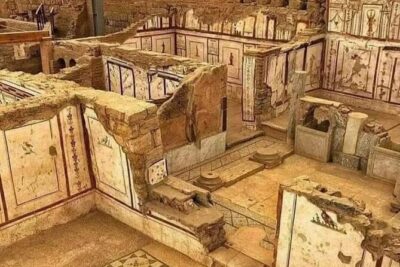
The Terrace Houses sit across from the Temple of Hadrian, cut into the slope of Bulbul Mountain. These were expensive Roman residences, and their preserved mosaics and wall paintings offer a rare look at family life rather than public ceremony.
Six residential units were built across three terraces. The oldest construction dates to the first century BC, and the homes remained in use until the seventh century AD. Protective roofing now covers the excavated area, and two houses are open as a museum.
This stop takes around 30 minutes and requires an extra €15 admission fee. For many people, it is worth the supplement. The Library and theatre show public Ephesus, while the Terrace Houses show how wealthy residents decorated floors, walls, and private rooms.
If you want to spend more time here, say so. The tour is tailor-made, and several guides have adjusted the route when a group wanted more archaeology and fewer commercial stops.
The Library of Celsus
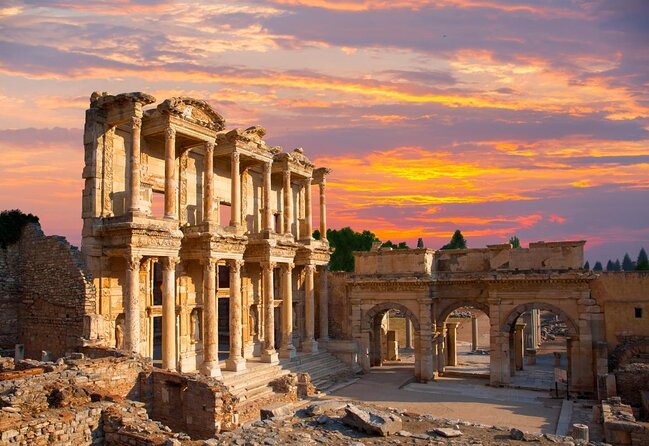
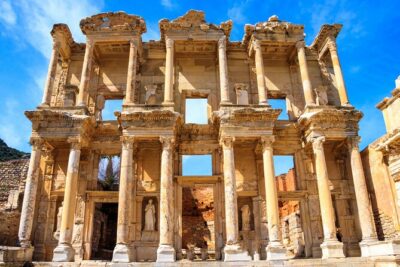
The Library of Celsus is Ephesus’s most recognizable facade. Built in AD 117 as a monumental tomb for Gaius Julius Celsus Polemaeanus, the provincial governor, it was funded by his son Gaius Julius Aquila.
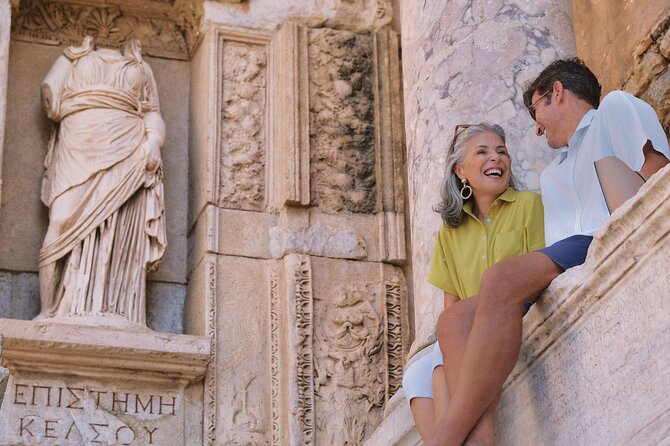
Celsus’s grave lay beneath the ground floor, directly across from the entrance. A statue of Athena, goddess of wisdom, was placed above it. The library once held more than 12,000 scrolls, stored in wall niches protected by double walls that helped shield them from heat, cold, and humidity.
You only have about 15 minutes listed here, but the facade deserves a thoughtful pause. Ask your guide to point out the architectural details and explain how the building served both memory and learning. This is one of the places where a good guide can turn a famous photograph into a meaningful stop.
The Great Theatre and the Christian connection
The Great Theatre is the largest structure in Ephesus and can hold about 25,000 people. It began in the Hellenistic period, around the third century BC, and was expanded under Roman rule.
The seating is arranged in three horizontal sections with walkways between them. The theatre hosted performances, concerts, political meetings, religious events, philosophical discussions, and gladiator or animal contests.
The theatre also connects to the early Christian story of Ephesus. Saint Paul preached in the city, and Christian tradition holds that Saint John spent his final years nearby. One guide, Tailan, was especially praised for explaining Christian history, reading passages from the Bible, and connecting religious traditions with the buildings around you.
The planned visit is about 15 minutes, but the view across the seating bowl gives you plenty to consider. The theatre is reached along a substantial archaeological route, so pacing matters. A private guide can tell when your group needs a pause.
St. John Basilica and the Temple of Artemis
The Basilica of St. John sits on the southern slope of Ayasuluk Hill. Tradition says Saint John was buried here, and a small chapel was built over the grave in the fourth century. Emperor Justinian later replaced it with a large basilica during his reign from AD 527 to 565.
The ruins are important for anyone tracing the development of Christianity in Asia Minor. The admission fee is €6 per person, and the visit takes about 30 minutes.
The nearby Temple of Artemis is one of the Seven Wonders of the ancient world. Today, only the foundations and a few scattered remains survive in a former marshy area. Some of the finest surviving architectural pieces are displayed in the British Museum in London.
The Artemis stop is free and takes about 25 minutes. It is visually modest, so keep your expectations realistic. Its importance comes from what once stood there: a huge marble temple dedicated to Artemis, a goddess connected with fertility and the ancient city’s identity.
Local lunch, weaving, and Kusadasi’s bazaar
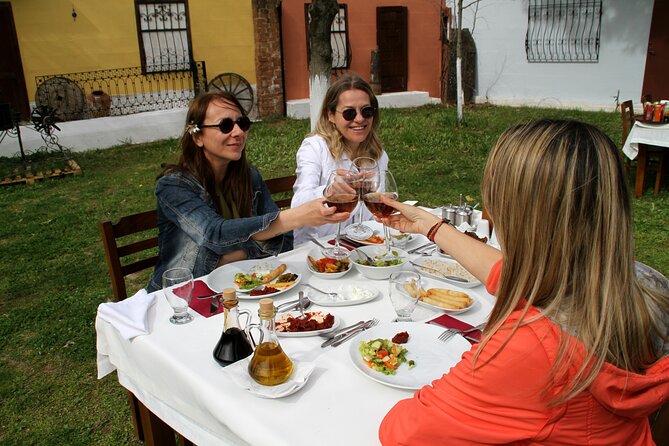
Lunch is included, and the meal is described as Turkish mezze and traditional local food. This is one of the more appealing parts of the day because it gives you a break from the ruins and a chance to taste something tied to the region.
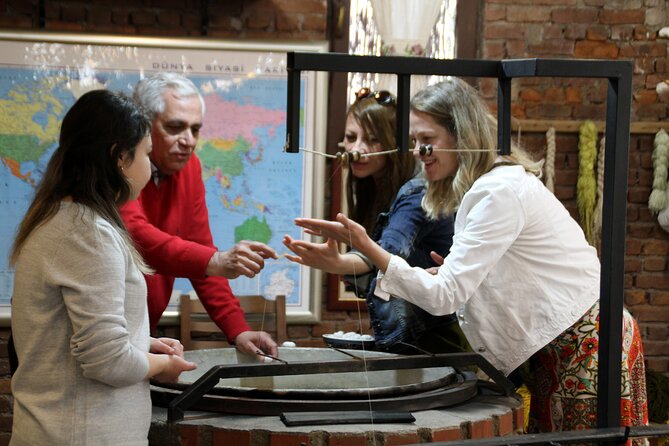
The lunch stop may be connected with a carpet-weaving school or cooperative. You might see a short demonstration of silk production, from mulberry leaves and silkworms to the silk thread, or watch local carpet-making techniques.
Be clear about your expectations. Some groups found the demonstration interesting and free of pressure. Others felt the rug presentation leaned toward a sales pitch. You can enjoy the cultural explanation without buying anything. If you already own Turkish carpets, tell the guide before the stop.
The final hour is free time at Kusadasi Bazaar. Shops sell Turkish goods, leather, sweets, souvenirs, watches, clothing, and assorted small items. It is a broad commercial market, not a carefully preserved historic quarter, so use the time for browsing, gifts, or a final look at local shopping rather than expecting a museum visit.
Öküz Mehmet Pasha Caravanserai is another short stop, about 10 minutes, and admission is free. Built between 1615 and 1618 as a fortified customs house, it reflects Ottoman trade along the port route. Its restoration lasted from 1954 to 1966.
Price, extra fees, and overall value
The base price is $75 per person, which is attractive for a full private day with a licensed English-speaking guide, private driver, air-conditioned Mercedes Vito, cruise pickup and drop-off, skip-the-line tickets, and lunch.
The important catch is that the entrance fees are separate:
- Ephesus Ancient City: €40
- House of the Virgin Mary: €18
- Terrace Houses: €15
- Basilica of St. John: €6
Visiting all four adds €79 per person. The Temple of Artemis, caravanserai, and Kusadasi Bazaar are free. A visit to Sirince Village is available for $50 per booking, but it is not part of the standard included plan.
For two people, the price is higher than joining a large bus excursion. In return, you get control over the day, direct access to a guide, a private vehicle, and no waiting for a full coach. For a family of four or five, the private format becomes easier to justify because the per-person price may compare more favorably with multiple individual tickets on a cruise excursion.
The biggest value comes from flexibility. Guides have allowed groups to skip Mary’s House, add the Ephesus Experience or archaeological museum, leave out St. John Basilica, or spend more time at the ruins. That is useful if you have strong priorities.
Who should book this Ephesus experience?
I would choose this tour if you are arriving by cruise, want a full day without a large group, or care about asking questions as you go. It also suits families, couples, and small groups with different interests.
History fans should request extra time at the Terrace Houses, Library of Celsus, and theatre. Visitors interested in Christianity should ask for a guide comfortable with the stories of Mary, Saint John, Saint Paul, and the early church. Anyone with limited mobility should discuss the hills, marble paving, and walking distances before the day begins.
You should think twice if you want the lowest possible price or dislike any stop connected with shopping. The carpet demonstration is not mandatory in spirit, but it can be part of the lunch setting. Also, the six to eight hour duration is demanding in hot weather.
Communication is a strong point. Guides have contacted customers the evening before, confirmed ship details, arrived promptly at the port, and checked the pace during the day. OTTI Travel offers free cancellation up to 24 hours before the start time, but changes or cancellations inside that window are not refunded.
Should you book it?
Book this tour if you want Ephesus explained well and shaped around your group rather than marched through on a fixed schedule. The strongest praise goes to the guides, especially Nagi, Asli, Selin, Ahmet, Tas, Sergen, and Tailan, who are repeatedly described as warm, clear, adaptable, and attentive.
I would book it for a cruise stop, particularly if Ephesus is a major reason for visiting Kusadasi. Just price in the admission fees, wear shoes with a firm grip, confirm your preferred stops in advance, and say plainly if you want to avoid carpet shopping. With those points settled, the tour offers a comfortable and unusually personal way to see one of Turkey’s great archaeological sites.
FAQ
How long does the private Ephesus tour last?
The experience lasts approximately six to eight hours.
Where does pickup take place for cruise passengers?
Cruise passengers meet the representative at the exit gate of the immigration terminal at Kusadasi Cruise Port. The representative carries an OTTI Travel sign.
Is hotel pickup available in Kusadasi?
Yes. For Kusadasi hotel pickup, the meeting point is the hotel reception.
Is airport pickup available?
Yes. Pickup is available at Izmir Airport, where you meet the representative at the exit gate of the domestic terminal with an OTTI Travel sign.
Are entrance tickets included?
No. The base price includes guaranteed skip-the-line tickets, but admission fees are paid separately. Ephesus costs €40, Mary’s House €18, the Terrace Houses €15, and St. John Basilica €6 per person.
Is lunch included?
Yes. A local lunch is included. Alcoholic drinks are not included.
Can the itinerary be changed?
Yes. This is a private tour, and the schedule can be adjusted to your group’s interests. You can request different stops or skip scheduled locations.
What is the cancellation policy?
You can cancel at least 24 hours before the experience for a full refund. Cancellations or changes made less than 24 hours before the start time are not accepted for a refund.
Just added around Kusadasi
- Kusadasi Boat Trip With Lunch And Hotel Transfer★ 4.5 · 63 reviews
- Pamukkale and Hierapolis★ 4.0 · 63 reviews
- FOR CRUISERS: Ephesus Tour from Kusadasi Port /GUARANTEED ON-TIME RETURN TO BOAT★ 5.0 · 64 reviews
- From Kusadasi/Selcuk: Highlights of Ephesus Small Group Tour★ 4.8 · 64 reviews
- Ephesus, Mary’s House, Artemis Tour(Private) (Skip the line)★ 5.0 · 64 reviews
- EPHESUS TOUR From Cruise Port: Private Tour & Skip The Line★ 5.0 · 65 reviews
- SKIP LINES Private Ephesus Tour for Cruise Guests ON TIME RETURN★ 5.0 · 66 reviews
- From Istanbul: Ephesus & Pamukkale 2-Day Trip with Flights★ 4.5 · 66 reviews
Ephesus & Virgin Mary Tours, compared.
FOR CRUISERS: Skip The Lines PRIVATE EPHESUS TOUR &On Time Return
Read our review →
ALL INCLUDED: Ephesus Ruins, Mary’s House Tour incl ENTRY TICKETS
Read our review →
SKIP-THE-LINE: Group & Private Ephesus Tour ENTRY FEE & LUNCH
Read our review →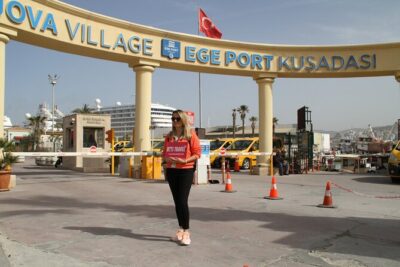
All Inclusive Private Access Ephesus Tour (SKIP-THE-LINE)
Read our review →Browse the lists this tour appears in