Reviewed · GUIDED
Seven Churches of Revelation 5 Days MINI Group Guided Tour
Walk through Revelation’s seven cities. This five-day circuit from Izmir links ancient ruins, early Christian sites, Roman roads, and Turkey’s Aegean towns in a way that gives the Bible’s letters a physical setting. I especially like the small minibus format, which keeps the group personal, and the guides’ willingness to explain both the biblical meaning and the political forces behind each city. I also like that hotels, entrance tickets, breakfasts, two dinners, and airport transfers are arranged for you.
The main drawback is the pace. You cover a great deal of western Turkey in four touring days, and several stops are brief. Some of the biblical churches are represented by modest remains rather than grand ruins, and the advertised price of $989 does not cover every meal or drink. You should also expect plenty of walking over uneven ancient stone.
In This Review
- Key points before you book
- Why this route gives Revelation a physical setting
- Arrival in Izmir and the first evening
- Pergamon and Thyatira: power, medicine, and trade
- Sardis and Philadelphia reveal two very different churches
- Laodicea and the thermal night at Pamukkale
- Ephesus brings the route to its grandest ruins
- Hotels, food, transport, and the real cost
- The guide can make or break the experience
- Who should book this five-day circuit?
- Should you book the Seven Churches tour?
- FAQ
- How long is the Seven Churches of Revelation tour?
- Which cities connected with the Seven Churches are included?
- What is included in the $989 price?
- Are lunches and drinks included?
- How large is the tour group?
- Is the tour physically demanding?
- What clothing is needed for religious sites?
Key points before you book
- Seven Revelation cities in five days: Pergamon, Thyatira, Smyrna, Sardis, Philadelphia, Laodicea, and Ephesus are covered, with Smyrna seen on a panoramic city ride.
- A guide-led history lesson: The tour connects Revelation and Acts with Lydian, Persian, Greek, Roman, Byzantine, and Ottoman-era stories.
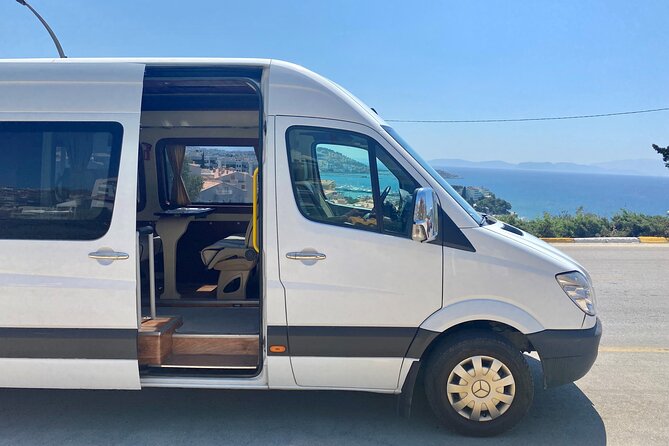
- Small groups capped at 15: The minibus setting allows questions and makes the route more suitable for families or older couples than a large coach.
- Four-star hotels included: Lodging is planned in Izmir, Pamukkale, and Kusadasi, with a thermal hotel near the white travertines.
- A demanding schedule: Long drives, hot outdoor sites, marble streets, slopes, and broken paving make moderate fitness important.
- Guide quality matters: Past praise has singled out Emre Dasdemir, Melih, Tez, Kerem Ozbas, Nahide, Inan, and driver Ali Kara for patient explanations and personal help.
Why this route gives Revelation a physical setting
Reading the Seven Churches of Asia on a page can make them feel like a list of names. This route changes that. You see how roads, trade, wealth, earthquakes, religious conflict, and imperial power shaped the communities addressed in Revelation.
The cities also differ sharply. Pergamon had royal ambition and a famous medical center. Sardis carried the memory of an older kingdom. Philadelphia was a smaller frontier city. Laodicea relied on commerce and its position at a road junction. Ephesus was a major port and religious center.
That variety is the tour’s real strength. You are not simply checking off seven ruins. You are comparing cities that had different fortunes and different pressures on their Christian communities.
The tour is Bible-oriented, but it is not limited to devotional commentary. A strong guide should explain where the biblical tradition is firm, where local belief enters, and where archaeology gives only partial answers. Emre Dasdemir has been praised for doing exactly that, including being candid when the historical record is less exciting than the popular story.
A few more tours and experiences worth a look
- 5-Day Aegean Tour – Gallipoli, Troy, Ephesus, Kusadasi, Pamukkale
★ 4.5 · 86 reviews
Arrival in Izmir and the first evening
Your arrival transfer begins at Izmir Adnan Menderes Airport. A representative meets you with a name sign and takes you to the hotel. If you are already staying in Izmir, pickup is offered after 2 p.m., followed by transfer to the hotel.
This first day is intentionally light. You get settled rather than being sent straight into a ruin under the afternoon sun. The plan includes dinner and an overnight stay in Izmir, although the cost details say dinner in Izmir is not included, so I would confirm exactly which evening meals are covered before departure.
Izmir, ancient Smyrna, is one of the seven churches. The city ride on the following evening gives you a broad introduction rather than an archaeological visit. You pass the marina, port area, and Clock Tower, while the guide explains Smyrna’s difficult past as a commercial city affected by conflict and warfare.
Do not expect a full walking tour of Smyrna’s ancient remains. The stop is mainly panoramic, and that is an important distinction. It lets you see the modern city that grew over the ancient one, but it is less satisfying if your goal is a major excavation at every church.
Pergamon and Thyatira: power, medicine, and trade

Day two begins with Pergamon, now Bergama. This is one of the most rewarding stops because the remains are dramatic even if you know little about the Bible.
The Acropolis rises above the town, and its theater is famous for its extremely steep seating. The height gives the site a memorable sense of scale, though anyone uneasy with steep steps should take care. The ancient city also had a major library, traditionally associated with a collection of more than 200,000 volumes, and Pergamon is linked with the development of parchment.
The Asklepion adds another layer. This was a renowned healing center in the classical world, where medicine, ritual, and public architecture came together. The guide’s job here is especially useful because the stones alone do not explain how the center worked.
The tour also connects Pergamon with the Throne of Satan mentioned in Revelation. That interpretation is tied to the city’s monumental religious structures, often associated with the Altar of Zeus. The altar itself is not viewed in its original setting, so your guide should explain the difference between what survives on site and what is known from museum collections and historical records.
After Pergamon, the route continues to Thyatira, now Akhisar. Compared with Pergamon, this is a quiet and fragmentary stop. You see the remains of a basilica and Roman architectural pieces rather than a large, fully exposed ancient city.
That modest setting is part of the lesson. Thyatira was associated with purple dye production, and Lydia, the seller of purple cloth in Philippi, came from this city. The commercial connection helps make the ancient community easier to picture, even when the visible ruins are limited.
The day ends back in Izmir. The combination of a spectacular archaeological site, a smaller church location, and a modern-city overview makes for useful contrast, but it is a long day in the vehicle.
Sardis and Philadelphia reveal two very different churches
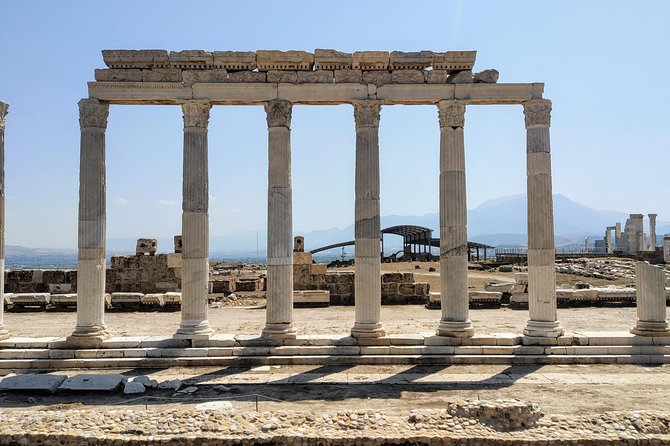
The third day starts early with Sardis, or Sardes. This was the capital of the Lydian kingdom in the sixth century BC, and its setting is among the most scenic on the route.
You visit the Temple of Artemis, the restored gymnasium, and a reconstructed synagogue. The remains show a city with large public ambitions, but Revelation presents Sardis as a church that is alive in name yet spiritually failing. That contrast gives the guide plenty to discuss.
You also see the final surviving section of the royal Persian Road from Susa to Sardis, associated with Cyrus the Great, along with the Pactolus River. The river was linked in antiquity with gold, which helps explain Sardis’s wealth and reputation.
Philadelphia, now Alasehir, offers a different experience. It was the only one of the seven churches not censured in Revelation, yet the physical remains are sparse. A Byzantine basilica survives with brickwork, a high arch, and some eleventh-century frescoes.
This is a good place to adjust your expectations. A biblical connection does not guarantee a grand ruin. Philadelphia is valuable for the setting and the discussion, not for a long list of intact buildings.
The stops at Sardis and Philadelphia are each listed at about an hour, so the guide has to be selective. Ask questions as you go. In a small group, you have a much better chance of getting a useful answer than you would on a large coach tour.
Something different for another day:
- FOR CRUISERS: Skip The Lines PRIVATE EPHESUS TOUR &On Time Return
★ 5.0 · 8,527 reviews - Top Choice For Cruisers: Ephesus, Mary’s House WITH TICKETS+LUNCH
★ 5.0 · 7,233 reviews - PRIVATE EPHESUS TOUR FOR CRUISERS: On-time Return and Skip-Line
★ 5.0 · 5,807 reviews - PRIVATE NO HIDDEN FEES Ephesus, Mary’s House Guided Tour /GRP OPT
★ 5.0 · 2,455 reviews
Laodicea and the thermal night at Pamukkale
Laodicea is the final church in the circuit. Founded in the third century BC by the Seleucid ruler Antiochus II and named for his wife, the city occupied an important crossroads near the Lycus River.
Its commercial position is central to understanding the place. Laodicea was not an isolated religious outpost. It was tied to trade, transportation, and regional wealth. The city’s role as a logistical center helps explain why its Christian community mattered and why its lukewarm reputation in Revelation carries such force.
The ruins can require imagination, since the site is spread out and exposed. Wear supportive shoes, carry water, and listen closely to the guide’s explanation of the roads and public buildings. The payoff comes from seeing the city as part of a working network rather than as a few disconnected stones.
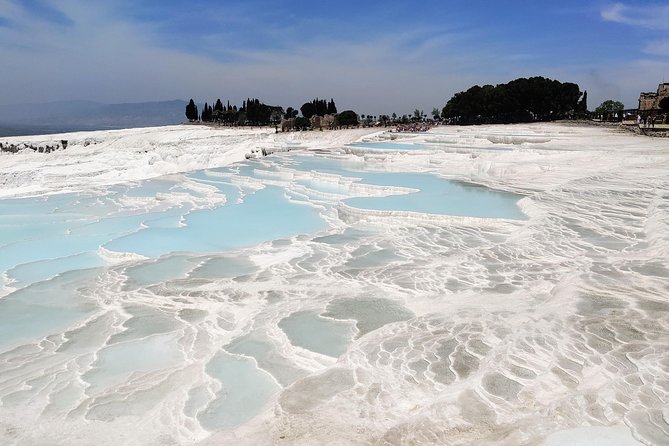
From Laodicea, you continue to Hierapolis and Pamukkale. Pamukkale means cotton castle, a fitting description for the white mineral terraces formed by hot spring water. The bright travertines are one of the most visually striking sights on the trip, but the visit is not only about photographs.
Hierapolis was an ancient healing city, and its hot mineral waters were known to the people who founded both Hierapolis and Laodicea. The thermal hotel overnight adds comfort after a full day of ruins and road time.
The exact amount of time at Pamukkale can vary with the day’s schedule, and the supplied timing gives only a very short entry line for the stop. I would ask before booking how much walking time is planned on the terraces and at Hierapolis. The overnight location is a practical advantage, since you are not forced to make the same long journey back to Izmir.
Ephesus brings the route to its grandest ruins
Day four centers on Ephesus, the largest and most polished archaeological experience on this route. Paul lived and preached here for three years, and the city received an epistle from him.
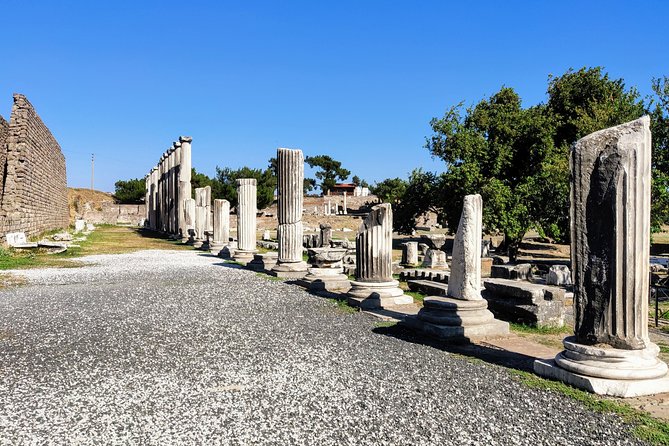
You walk along marble streets past the Baths of Scholastica, the Library of Celsus, the Temple of Hadrian, and the theater. Excavation continues, so the site can feel like an active historical project rather than a finished display.
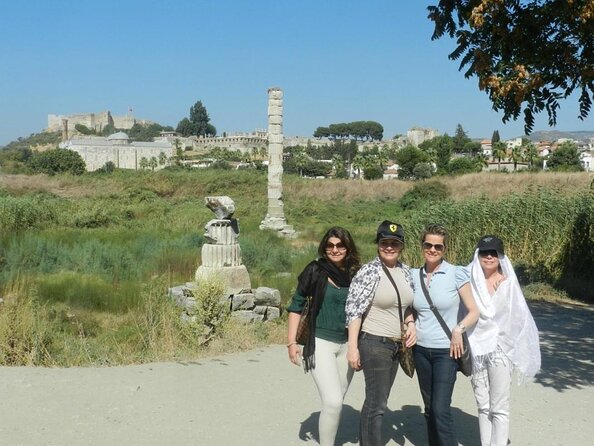
Ephesus was also home to the Temple of Artemis, once counted among the Seven Wonders of the Ancient World. Only limited remains are visible at the temple site today, but its former importance explains why Ephesus drew pilgrims, merchants, and political attention.
Expect more walking here than at most other stops. The paving can be uneven, and the sun can be strong. The ancient streets are impressive, but they are not easy on tired legs. The tour’s own guidance about moderate fitness should be taken seriously.
The House of the Virgin Mary comes next, high in the Aladag Mountains about five miles from Ephesus. Christian tradition holds that Mary came to Ephesus with St. John and lived there until her death. The location became a pilgrimage site after its recognition by the Archbishop of Izmir in 1892, and Pope Paul VI visited in 1967.
This is a place of active devotion, not simply another ruin. Dress modestly, keep your voice low, and allow room for worshippers. One particularly thoughtful guide, Tez, arranged the timing so a couple could attend a Sunday service at the house. That detail captures the value of a good guide: not just facts, but attention to what matters to you.
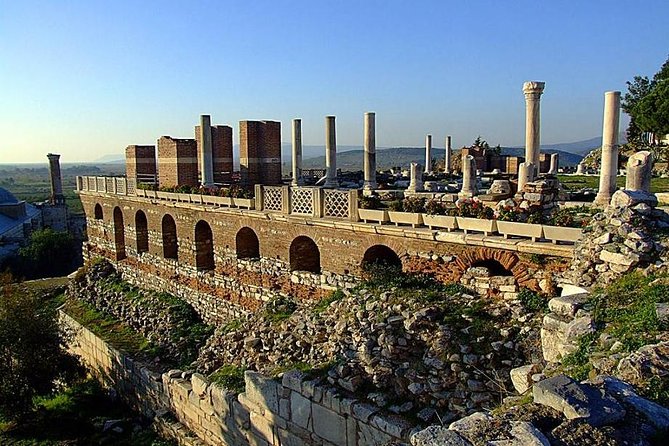
St. John’s Basilica is the next stop. It was built over the place traditionally associated with the evangelist’s burial on Ayosolug Hill. The ruins connect the apostolic tradition with the later Byzantine Christian world.
The day ends with a short visit to the Temple of Artemis and then Kusadasi. The resort town portion includes the marina, port, caravanserai, and Grand Bazaar. It is a brief orientation, not a full shopping afternoon.
Hotels, food, transport, and the real cost
At $989 per person, the price is not a budget backpacker rate, but it covers the pieces that are hardest to arrange on your own. You receive four nights in centrally located four-star hotels, four breakfasts, two dinners, private transport within the small group, entrance fees, and airport transfers.
The listed hotels include DoubleTree by Hilton Alsancak or Hilton Garden Inn Bayrakli in Izmir, Colossae Thermal or Pam Thermal Hotel near Pamukkale, and Efe Boutique Hotel or a similar property in Kusadasi. Substitutions are possible, so treat those names as examples rather than guarantees.
Prepaid entrance tickets are a useful convenience. You do not need to stop at every ticket window, and the guide can keep the group moving. This matters most at Ephesus and other popular archaeological sites.
Lunches, drinks, unlisted meals, flights, and gratuities are extra. Dinner in Izmir is specifically excluded in the cost details, while two dinners are included overall. Budget for those gaps rather than assuming the package covers full board.
You can upgrade to five-star hotels for an additional $135 per person in a double room. I would only pay that if hotel comfort is central to your trip. The standard package already places you in four-star properties, and the route’s main value is the guiding and transport.
The guide can make or break the experience
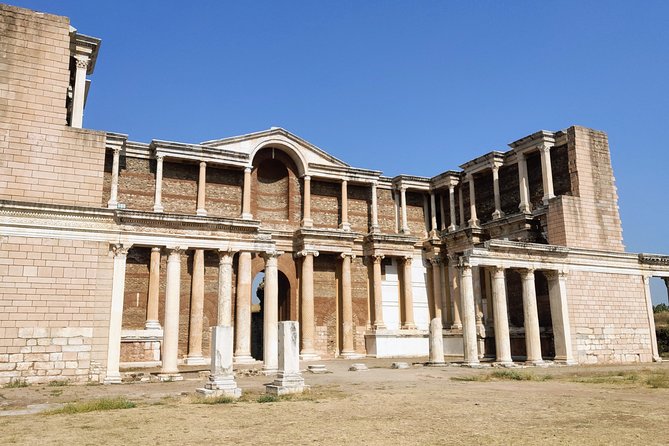
The strongest praise has gone to the guides. Emre Dasdemir is singled out for detailed answers, honesty, concern for safety, and a willingness to adjust the schedule. He reportedly helped with vendor negotiations, handled changes fairly, and even returned saved funds when plans changed.
Melih is also praised for making the historical setting of the seven churches clear and for adapting to questions. Kerem Ozbas has been described as both personable and deeply prepared, especially when guiding a very small group.
Nahide, who has worked in the field for 35 years, received strong praise for her warmth and command of the subject. Inan was appreciated for being generous and kind, while driver Ali Kara was recognized for helpful, good-natured service. Because guide assignments can change, you should not assume a particular person will lead your departure, but these names show the standard the company has sometimes delivered.
The small-group limit is 15 people, and the tour can operate with only two people booked. That flexibility is valuable. A pair may receive something close to a private tour, while a family can ask questions without holding up a large bus.
Who should book this five-day circuit?
I would recommend it to readers who want biblical context but also care about archaeology, ancient politics, and everyday history. It suits people who prefer having transport and hotels handled, especially when visiting sites spread across western Turkey.
Families may appreciate the small group and private-feeling minibus. Couples and older adults should think carefully about the walking and early starts. The route is not designed for a slow holiday.
If you have already seen Istanbul, Cappadocia, and the usual Turkish highlights, this circuit gives you a different side of the country. It moves away from the standard postcard route and focuses on ancient cities that shaped the eastern Mediterranean.
Bring modest clothing for churches, monasteries, mosques, synagogues, and selected museums. Shoulders and knees must be covered, and shoes must be removed in mosques. Failure to follow the dress rules can lead to refused entry.
Vegetarian food is available if requested at booking. The tour requires at least two people per booking, and cancellation is free if made at least three full days before the start time. Changes or cancellations inside that window are not refunded.
Should you book the Seven Churches tour?
Book it if you want a guided, Bible-centered route through western Turkey and would rather spend your energy at the ruins than on hotel research, ticket queues, and intercity driving. The best reasons to go are the small group, the thoughtful guides, the thermal overnight near Pamukkale, and the unusual mix of major ruins with quieter church sites.
Skip it if you want long stays at each excavation, generous free time, or a low-cost independent trip. The schedule is tight, Smyrna is mainly a panoramic stop, and not every church offers impressive standing remains.
For the right reader, $989 is fair value. You are paying for coordination, not just admission tickets. Ask about the assigned guide, exact hotel names, included dinner nights, and the amount of free time at Pamukkale before you commit.
FAQ
How long is the Seven Churches of Revelation tour?
The tour lasts approximately five days and includes four nights of accommodation.
Which cities connected with the Seven Churches are included?
The route includes Pergamon, Thyatira, Smyrna, Sardis, Philadelphia, Laodicea, and Ephesus. Smyrna is visited through a panoramic ride in Izmir.
What is included in the $989 price?
The price includes four nights in four-star hotels, four breakfasts, two dinners, air-conditioned minibus or minivan transport, entrance fees, a licensed Bible-oriented guide, and airport transfers.
Are lunches and drinks included?
No. Drinks and meals not specifically listed are extra. Dinner in Izmir is also listed as not included.
How large is the tour group?
The tour has a maximum of 15 travelers and requires a minimum of two people per booking. A private tour option is also available for families.
Is the tour physically demanding?
You should have a moderate fitness level. Expect considerable walking at ancient sites, including uneven marble streets, steep areas, exposed ruins, and outdoor paths.
What clothing is needed for religious sites?
Both men and women must cover their knees and shoulders at places of worship and selected museums. Shoes must be removed in mosques, and failure to follow the dress code may result in refused entry.
Just added around Kusadasi
- Best of Ephesus Private Tour FOR CRUISE GUESTS / On Time Return★ 5.0 · 17 reviews
- Kusadasi: Full–Day Boat Trip with Lunch★ 4.3 · 18 reviews
- Istanbul: 8-Day Cappadocia, Ephesus, Konya, Pamukkale Tour★ 4.9 · 18 reviews
- “Ephesus tours” the “house of virgin mary tours” Tours from KUSADASI CRUİSE PORT★ 5.0 · 18 reviews
- Small Group Ephesus Tour from Selcuk / Kusadası★ 5.0 · 18 reviews
- From Istanbul: 2-Day Ephesus, Pamukkale, & Hierapolis Tour★ 4.1 · 18 reviews
- Cesme: Small Group Boat Tour with Open Buffet Lunch★ 4.5 · 18 reviews
- Ephesus Shore Excursion from Kusadasi Port with Guide★ 5.0 · 18 reviews
Guided, compared.
Daytime or Sunset Sightseeing Cruise & Audio Guide
Read our review →
Best of Istanbul 1, 2 or 3-Day Private Guided Istanbul Tour
Read our review →
Topkapi Palace & Harem Museum Ticket & Audio Guide
Read our review →
Blue Mosque & Hagia Sophia Guided Tour w/ Tickets
Read our review →
Bosphorus Sunset Cruise on Yacht with Live Guide
Read our review →
Bosphorus Sightseeing Cruise Tour with Audio Guide
Read our review →
Hagia Sophia Skip-the-Line Ticket and Audio Guide
Read our review →